Finding a suitable surgeon in Thane requires more than entering “laparoscopy specialist near me” and choosing the first result. You will be able to search local hospital and clinic directories, compare training and operative experience, and prepare questions that reveal whether laparoscopy is the right procedure for your condition.
Key takeaways
- Compare hospital websites with independent doctor listings.
- Verify registration, training and experience with your exact procedure.
- Ask about alternatives, hospital facilities, risks, fees and follow-up.
- Confirm recovery restrictions and warning signs before leaving the consultation.
Where to search for a laparoscopic gynaecologist in Thane
Begin with hospital websites in Thane, then compare the surgeon’s own clinic page with independent listings. Search “laparoscopic gynaecologist in Thane” and “laparoscopy specialist near me,” but treat those phrases as search labels, not proof of expertise.
Shortlist doctors using these local sources:
- Hospital directories: Check the gynaecology department, affiliated hospitals, operation facilities, emergency services, and contact details.
- Clinic websites and Google Maps profiles: Compare consultation locations, patient reviews, listed procedures, and whether the doctor names the hospital where surgery takes place.
- Practo, Justdial, and similar directories: Use them to find alternatives, but confirm every qualification, procedure, and review with the clinic.
- Referrals from your gynaecologist or fertility clinic: Ask whether the recommended surgeon performs your proposed operation or refers surgical cases elsewhere.
| Source | What you can compare | Check before booking |
|---|---|---|
| Hospital directory | Affiliation, facilities, emergency support | Who will operate and whether the hospital grants privileges for that procedure |
| Clinic profile | Procedures, consultation location, contact process | The doctor’s recognised obstetrics-and-gynaecology qualification and laparoscopic training |
| Independent listing | Reviews, availability, nearby clinics | Current case experience; listings can be outdated |
| Personal referral | Relevance to your condition | Where anaesthesia, imaging, blood products, intensive care, and complication care are available |
Ask where tissue goes for histopathology, how results are communicated, and who provides anaesthesia. A convenient clinic is not enough if suspected ectopic pregnancy, severe endometriosis, heavy bleeding, or a complex pelvic mass requires hospital resources.
How to check a surgeon’s qualifications and experience
A medical degree and the label “laparoscopy doctor in Thane” do not prove that a surgeon is equipped for your operation. Look for recognised obstetrics-and-gynaecology training, documented laparoscopic surgery training, current practice, and hospital privileges for the specific procedure.
Ask for evidence in this order:
1. Confirm the doctor’s recognised postgraduate qualification in obstetrics and gynaecology, current medical registration, and additional training in laparoscopic surgery. A short course alone is not equivalent to structured surgical training.
2. Ask how many procedures like yours the doctor has performed recently. “Laparoscopy” covers diagnostic inspection, ovarian cyst removal, ectopic pregnancy treatment, adhesiolysis, fibroid surgery, and endometriosis operations; experience in one does not prove experience in another.
3. Verify that the hospital grants the surgeon privileges for your proposed operation and has anaesthesia, blood-bank, imaging, intensive-care, and emergency surgical support. Ask who will perform each part of the operation.
4. If endometriosis is suspected, ask specifically about deep disease involving the bowel, bladder, or ureter. A general keyhole surgeon and a surgeon experienced in complex endometriosis are not interchangeable choices.
The consent discussion should name the planned procedure, state whether it is diagnostic or operative, and explain conversion to open surgery if bleeding, dense adhesions, organ injury, cancer concerns, or poor visibility make laparoscopy unsafe. Choose a laparoscopic surgeon for women in Thane who answers with procedure-specific evidence rather than broad claims.
Match the doctor to your condition and proposed procedure
The right surgeon depends on both the diagnosis and the operation planned. For gynaecological laparoscopy in Thane, confirm that the doctor has specific laparoscopic training, current experience with your procedure, and hospital privileges for it—not just a general gynaecology qualification.
| Problem or proposed procedure | Laparoscopic fit | When another route fits |
|---|---|---|
| Pelvic pain or suspected endometriosis | Diagnostic inspection, biopsy, or removal of visible lesions | Deep disease involving the bowel, bladder, ureter, or severe symptoms needs a complex endometriosis specialist; a normal-looking pelvis does not exclude every lesion |
| Ovarian cyst or ectopic pregnancy | Cyst removal or treatment of a suitable ectopic pregnancy | Ultrasound surveillance fits a simple, small cyst; emergency open surgery may be safer with major bleeding or an unstable patient |
| Fibroid or adhesions | Selected myomectomy or adhesiolysis | Medication, uterine-artery treatment, hysteroscopic removal, or open surgery can suit the fibroid’s size and location |
| Infertility | Tubal assessment or treatment of selected adhesions or endometriosis | Do not use laparoscopy as a universal first fertility test; complete semen, ovulation, tubal, ultrasound, and age-related assessment first |
| Heavy bleeding or suspected uterine polyp | Laparoscopy does not examine the uterine cavity | Hysteroscopy examines and treats the cavity; medication or observation may be enough |
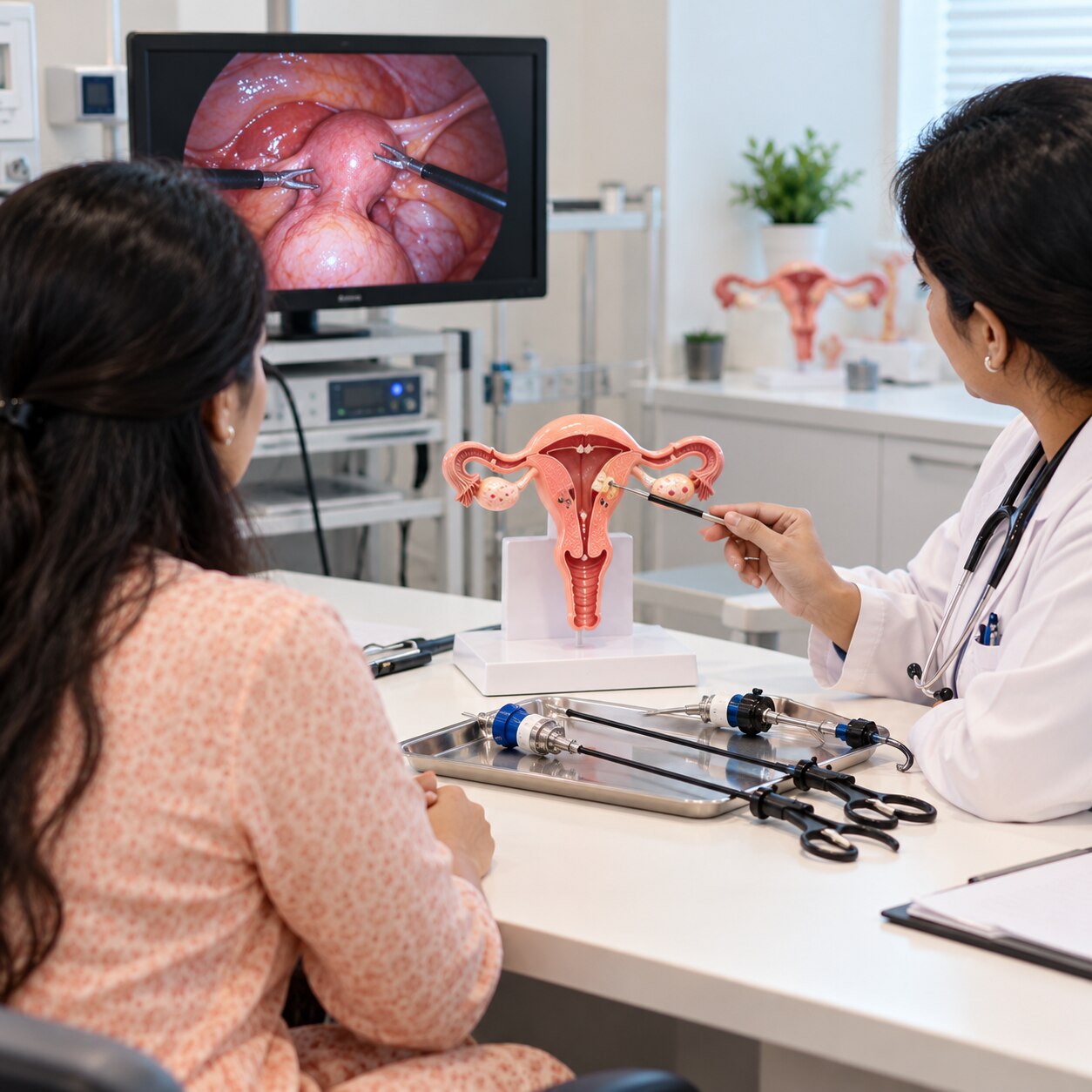
Ask whether the plan is diagnostic or operative, what happens if nothing abnormal appears, and whether removed tissue goes for histopathology. A laparoscopy doctor in Thane should explain the alternative, expected benefit, possible adhesions, and why surgery is preferable to medication, imaging, hysteroscopy, or watchful waiting.
Questions to ask during your consultation in Thane
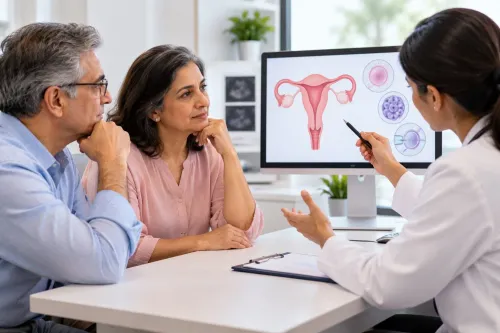
Before booking, ask the surgeon to explain the diagnosis, the planned procedure, and the backup plan in plain language. Use the same checklist whether you found a laparoscopy doctor in Thane through a hospital directory or a personal referral.
1. Which tests confirm the diagnosis? Ask whether you need an ultrasound, MRI, blood tests, or a pregnancy test. Clarify what happens if laparoscopy finds no abnormality, whether removed tissue will go for histopathology, and how you will receive the results.
2. Who will provide anaesthesia? Ask about fasting, medication adjustments, allergies, expected pain control, and recovery-room monitoring. If you are pregnant, ask how fetal assessment and obstetric involvement will affect timing and anaesthesia.
3. What can go wrong? Discuss bleeding, infection, bowel, bladder, or blood-vessel injury, and conversion to open surgery when visibility is poor or safety requires it. Ask who manages a complication and which symptoms require emergency review.
4. What are the alternatives? Compare hysteroscopy, ultrasound or MRI-guided assessment, medication, watchful waiting, and open surgery. Hysteroscopy examines the inside of the uterus; laparoscopy examines the abdomen and pelvis.
5. Which hospital will provide care? Confirm the operating surgeon, hospital privileges, blood products, imaging, intensive care, and access to another specialist. Ask how long you may stay away from work and who handles after-hours concerns.
Dr. Mrs. Pradnya J. Gavali - Gynaecologist can use these answers to tailor counselling, particularly when pregnancy, infertility, or a complex pelvic mass changes the decision.
Related service
Laparoscopic Gynaecologist Laparoscopic gynaecology is a modern minimally invasive surgical approach used to diagnose and treat various gynaecological conditions with small... View service → |
What to expect during recovery and follow-up
Choose a facility that can manage the whole recovery, not just perform the keyhole operation. Laparoscopy can become open abdominal surgery if bleeding, dense adhesions, organ injury, cancer concerns, or poor visibility make continuing unsafe. Conversion is a safety decision, so consent should explain it before surgery.
Recovery depends on the operation. Diagnostic laparoscopy may allow a quicker return to routine activity, while extensive endometriosis surgery, bowel or bladder repair, or laparotomy requires longer restrictions. Treat a fixed “full recovery in seven days” promise cautiously.
Before booking, confirm that the hospital provides:
- Written instructions for walking, bathing, wound care, lifting, driving, sex, work, and medicines
- A scheduled review with the operating surgeon, including when stitches, pathology results, or scan results will be discussed
- A 24-hour contact number and a clear emergency route after discharge
- Access to blood products, imaging, anaesthesia support, intensive care, and specialists who can treat bowel, bladder, or major bleeding complications
- Treatment for warning symptoms such as worsening abdominal pain, fever, repeated vomiting, heavy vaginal bleeding, faintness, breathlessness, inability to pass urine, or a red, swollen, draining wound
Ask who will perform the operation, who will provide anaesthesia, and where you should go at night or on weekends. A nearby clinic is not enough if it cannot admit you or arrange urgent surgical care.
Frequently asked questions
Where can you search for a laparoscopic gynaecologist in Thane?
Start with hospital websites in Thane, then compare the surgeon’s clinic page with independent listings. Use “laparoscopic gynaecologist in Thane” and “laparoscopy specialist near me” as search labels, not proof of expertise.
How do you check a laparoscopic surgeon’s qualifications and experience?
Check the doctor’s medical registration, postgraduate gynaecology qualification, additional laparoscopic training and experience with your proposed procedure. Ask which hospital they operate in and how follow-up is arranged.
How do you match a doctor to your condition and procedure?
Ask whether the surgeon regularly treats your condition, such as endometriosis, ovarian cysts, fibroids, infertility or pelvic pain. Confirm whether diagnostic laparoscopy, operative laparoscopy or another treatment is appropriate for you.
What questions should you ask during a consultation in Thane?
Ask why laparoscopy is recommended, what alternatives exist, which hospital will be used, what the procedure includes, the likely recovery time, total fees, anaesthesia arrangements and warning signs after surgery.
What should you expect during recovery and follow-up?
Ask when you can walk, work, drive, exercise and resume sexual activity. Confirm the follow-up date, wound-care instructions and symptoms that require urgent medical attention.
Keywords