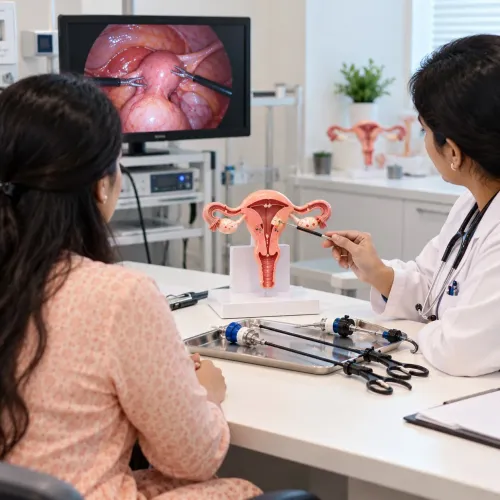

After two or more pregnancy losses, you do not need to wait passively for another miscarriage before asking for a structured assessment. You will learn which specialist to contact first, what to bring to the appointment, which tests have a clear clinical role, and how to compare clinics in Thane before booking.
Key takeaways
- Discuss evaluation after two miscarriages; do not wait for a third.
- Start with an obstetrician-gynaecologist experienced in recurrent pregnancy loss.
- Bring pregnancy records, scan reports, test results and a complete medication list.
- Ask which tests change treatment before agreeing to a large testing package.
When does one miscarriage become a recurrent-loss evaluation?
Two miscarriages are enough to discuss a recurrent-loss evaluation; you do not need to wait for a third. The American College of Obstetricians and Gynecologists (ACOG) recommends examination and testing after two miscarriages.
The Royal College of Obstetricians and Gynaecologists (RCOG) traditionally defines recurrent miscarriage as three or more first-trimester miscarriages, but supports assessment after two when a medical cause is suspected.
Timing changes the decision. Arrange earlier specialist review after a second-trimester loss, an ectopic or molar pregnancy, or when you have thyroid disease, diabetes, autoimmune disease, or another known condition. A recurrent pregnancy loss doctor in Thane can decide which tests fit your history rather than ordering an identical panel for everyone.
Do not wait for a scheduled evaluation if early-pregnancy symptoms suggest an emergency:
- Heavy bleeding or dizziness
- Severe or one-sided abdominal pain
- Shoulder-tip pain or fainting
- Fever or feeling seriously unwell
These symptoms can indicate ectopic pregnancy, major blood loss, or infection and need urgent emergency care. A routine miscarriage assessment cannot safely replace it.
Most early miscarriages result from a sporadic chromosomal problem in the embryo, with risk increasing with maternal age. Even after repeated losses, testing may find no correctable cause; that does not mean you caused the miscarriage.
Which specialist should you see first in Thane?
For a doctor for repeated miscarriages in Thane, start with an obstetrician-gynaecologist who regularly evaluates recurrent pregnancy loss. You do not need to wait for three losses: assessment after two is supported by ACOG, while a second-trimester loss, ectopic or molar pregnancy, symptoms, or a known medical condition warrants earlier review.
A general gynaecologist can begin the evaluation, but a repeated miscarriage specialist in Thane may coordinate additional referrals:
| Specialist | When referral is appropriate |
|---|---|
| Obstetrician-gynaecologist | First assessment, pregnancy planning, and review of uterine or medical causes |
| Reproductive endocrinologist or fertility specialist | Difficulty conceiving, infertility treatment, diminished ovarian reserve, or repeated early losses |
| Genetic counsellor | Abnormal pregnancy-tissue genetics, a family history of inherited disease, or suspected parental chromosome rearrangement |
| Haematologist | Confirmed or strongly suspected antiphospholipid syndrome or another documented blood disorder |
| Endocrinologist | Thyroid disease, diabetes, pituitary problems, or other hormonal conditions needing specialist management |
| Maternal-fetal medicine specialist | A complex pregnancy, second-trimester loss, serious maternal illness, or high-risk pregnancy planning |
Before booking, ask whether the clinic reviews both partners’ histories, interprets pregnancy-tissue or genetic results, and arranges referrals rather than ordering an unselected “miscarriage panel.” Finding no correctable cause is common; it does not mean you caused the loss.
What should you take to the first appointment?
Take one folder, digital or printed, to the doctor for repeated miscarriages in Thane. Arrange the records by pregnancy and add a one-page timeline showing the last menstrual period, positive pregnancy-test date, ultrasound dates, gestational age at loss, symptoms, and treatment.
- Bring every ultrasound report, including early scans that recorded a heartbeat, growth, or an empty gestational sac.
- Add hospital discharge summaries, emergency notes, operation records, and anaesthesia details from each miscarriage, ectopic pregnancy, or pregnancy-related admission.
- Include pathology reports for pregnancy tissue, placenta, or products of conception, along with fetal or placental genetic results such as chromosomal microarray or karyotype.
- List every medicine and supplement, including dose and dates, plus prior treatments such as progesterone, aspirin, heparin, thyroid treatment, diabetes treatment, or surgery.
- Write down menstrual-cycle patterns, previous pregnancies and births, thyroid or diabetes history, autoimmune conditions, family history, and allergies.
Ask your partner to provide their medical and surgical history, medicines, fertility history, previous genetic testing, and family history of miscarriages or chromosome conditions. Reviewing both partners’ histories helps identify inherited chromosome risks, shared medical factors, and treatment decisions that records from only one person could miss.
Take the actual reports rather than relying on memory.
What does a well-planned miscarriage evaluation include?
A careful evaluation starts with your history, not a large “miscarriage panel.” A recurrent pregnancy loss doctor in Thane will first build a chronology of every pregnancy: test dates, gestational age, ultrasound findings, bleeding or pain, treatment, pathology, genetic results, menstrual history, medicines, medical conditions and family history.
1. The examination usually includes a pelvic or transvaginal ultrasound to assess the uterus, ovaries and pregnancy-related findings. The doctor may then assess the uterine cavity, where a septum, polyp, fibroid or scar could affect implantation or pregnancy development.
2. Blood tests commonly include thyroid-stimulating hormone testing and antiphospholipid antibody testing. Diabetes screening applies when your history, symptoms, examination or risk factors indicate it; prolactin testing or other endocrine tests also need a clinical reason.
3. Genetic counselling is selective, not automatic. Consider it when pregnancy-tissue results suggest a chromosomal problem, the family history raises concern, or the pattern of losses points to an inherited risk.
The uterine-cavity test depends on the question:
| Option | What it shows | When it applies |
|---|---|---|
| Saline-infusion sonography | Saline outlines the cavity during ultrasound | Suspected polyp, fibroid, septum or scar |
| Hysteroscopy | A camera directly views and can treat cavity lesions | An abnormality needs confirmation or removal |
| Hysterosalpingography | X-ray outlines the cavity and fallopian tubes | Cavity and tubal assessment are both relevant |
| MRI | Detailed images of uterine structure | Ultrasound findings are unclear or complex anatomy is suspected |
You do not need every scan or surgery automatically. A miscarriage evaluation clinic in Thane should explain what each test could change before ordering it.
How can you compare clinics and avoid unnecessary testing?
A strong miscarriage evaluation clinic in Thane coordinates the work-up instead of ordering every available test. Before booking, ask whether the doctor reviews both partners, arranges pregnancy-tissue or products-of-conception chromosomal testing when appropriate, explains results, plans follow-up, and refers complex cases.
| Clinic feature | What to confirm | Why it matters |
|---|---|---|
| Established evaluation | Antiphospholipid antibody testing, thyroid testing, and uterine-cavity assessment based on your history | These tests address recognised causes without treating every patient alike |
| Pregnancy-tissue testing | Chromosomal testing of products of conception when tissue is available and the result could guide care | It can explain an individual loss and determine whether parental chromosome testing is worth considering |
| Partner assessment | Review of the partner’s medical, reproductive, family and medication history | A couple’s history can change genetic and fertility referrals |
| Specialist coordination | Access to a fertility specialist, genetic counsellor, endocrinologist, haematologist or maternal-fetal-medicine specialist | Referral should match the finding, not follow a fixed package |
| Tests requiring a reason | Immune panels, natural-killer-cell tests, routine inherited-thrombophilia testing, sperm DNA fragmentation and broad hormone panels | Unclear results can lead to expensive treatments without proven benefit |
A repeated miscarriage specialist in Thane should tell you which result would change management before ordering it. Dr. Mrs. Pradnya J. Gavali - Gynaecologist can provide this history-led review, coordinate referrals when needed, and set a specific follow-up plan rather than leaving you to interpret a long test list alone.
Frequently asked questions
When should you seek a recurrent pregnancy loss evaluation?
Discuss an evaluation after two miscarriages. ACOG recommends examination and testing at that point rather than waiting for a third loss.
Which doctor helps after more than one miscarriage in Thane?
Start with an obstetrician-gynaecologist who evaluates recurrent pregnancy loss. They can review your history, order appropriate tests and refer you to genetics, reproductive medicine or another specialist when needed.
What should you take to a miscarriage evaluation appointment?
Bring ultrasound reports, pregnancy and hospital records, pathology or genetic reports, blood-test results, medication details and a timeline of each pregnancy and miscarriage.
What can a recurrent miscarriage evaluation include?
A planned evaluation can include a detailed pregnancy history, physical examination, assessment of the uterus, selected blood tests and review of genetic or medical factors. The tests should match your history.
How can you avoid unnecessary miscarriage testing?
Ask what each test is looking for, whether the result changes treatment and whether a recognised guideline supports it. Be cautious about large packages with no explanation of how results will be used.
Keywords